
In my KU Leuven PhD thesis (revised and shortened, available as a book here, On the Possibility of a Digital University: Thinking and mediatic displacement at the university), I wrote about the discovery of writing and reading techniques in the Middle Ages as a revolution that changed how people think and use tools for that. I relied a lot on the work of Ivan Illich and his brilliant book on the 12th-century silent reading revolution, In the Vineyard of the Text. Thinking back now, I realise that my PhD discussion was partly guided by what I could only frame as economic logic: what is the gain or benefit of these new techniques of reading and writing? More thinking, hence more innovation! Very simply, writing indirectly leads to profit by generating gains in knowledge. I say I did this in my thesis “partially” because I had other chapters where I argued for the sheer joy and pleasure of thinking while speaking (in lectures and seminars), and that these should not be subject to any economic logic of teaching as knowledge transmission.
The silent reading revolution of the 12th century meant that people – scholars and monks mostly – learned to be more efficient with how they read a text: once they invented visual writing and reading, they could go straight to the passage that mattered to them, skim and skip lines of text, and use the glossary to search. This meant they could read more books in less time and accumulate knowledge. This led later to a kind of despair that Anne Blair talks about in her book Too much to know. Reading faster led to more writing, more publications, more stuff to know. Hence the despair.
I’ve recently come to regret the implicit economic framing I previously adopted when discussing writing and reading as practices for accumulating and growing the body of knowledge. Under our current late-stage capitalist logic, this has direct consequences that we are seeing now in our digital practices of reading and writing. Capitalism always pushes things to their extreme logic. If writing and reading practices foster innovation and wealth (via knowledge production, not direct gains…), then we should seek to optimise them and extract the best out of our practices. That’s the maximising logic. If reading and writing are good for thinking, can we make them better? “Hold my beer!” said the digital innovator.
This economic mindset/logic has now led us to abandon writing as a tool for thinking. Because it’s inefficient as hell. When I was doing my PhD at KU Leuven, I was at the same time learning to read and write anew, tailored for the academic world of Western Universities, which entails certain ways of thinking and approaching scholarship. And one of the things I learned, not from my instructors, but just from the environment, was that one should read like a pirate. Pirates plunder. They come, they loot, and they run away. Reading a text like a pirate means you don’t read it from beginning to end. No, that’s for beginners, innocent PhDs like I was who thought a text should be cherished. No. You are supposed to quickly look through the abstract, then go immediately to the section you’re interested in, harvest a few citations or points that would be useful for your own benefit, and then move on. This would be the economic logic of reading and writing, not as practices in themselves, but as this plundering – get what’s useful, discard the rest. Reading and writing in academia have already changed a lot, even before this type of advice emerged, a la reading like a pirate advice. For centuries now, academics and scholars have been immersed in a revolution to make our reading and writing practices as optimal as possible. Read like a pirate was just a joke-y way of putting it. But there was a trend.
Especially looking at the changes in the digital revolution, which put reading and writing on steroids because now you can search, you don’t even need to look with your eyes, you can search for the words in the text. It’s very instrumental how we read now, very efficient and targeted. I don’t even know the faces of these people I’m citing. I never did.
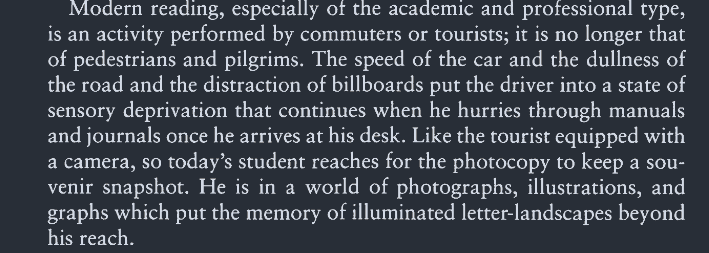
Anything that has to do with research or knowledge accumulation has changed in the last century due to the digital revolution, meaning it has become even more economical. So if I were to push today the argument I did in my PhD that writing and reading are conducive to thinking, then this would be a losing argument, because actually thinking, innovation and knowledge can be done much faster by partially at least automating the process. Enter LLMs.
This is what large language models do, and that’s why they’re so hard to resist for many academics. The academic world is split: many in the humanities are completely against them, but many in computer science, hard sciences, biology, chemistry, and even social sciences like sociology and psychology are OK with LLMs. It speeds up their work, and this is all we want: to speed up the thinking and to remove that friction that was behind the wasteful acts of reading and writing. Now we can do it much more targeted. We can do targeted searches, citation hunting, clustering and citation maps, and look for gaps in an almost automatic way. So why hold on to these very outdated practices of reading with your eyes and writing by hand, or of writing words that you author rather than generate?
There is an answer to this, but it’s not economic. The answer is epistemic because this is how we come to know historically. If we still want to stay in the economic realm, there is also an answer that we still need people as random word generators, because true human randomness cannot be replicated by large language models. Thinking follows chaos theory, and we don’t know how we think. We just noticed that certain practices help us come up with ideas, but the ideas are really random, and machines cannot get them, so we still need to keep at least a portion of our population literate and hence able to do this kind of wasteful, full of friction and creative process that is reading and writing by hand with your eyes. Like chickens in a free-range environment, we will still need a few samples of organic intellectual work in a world flooded by AI text. But please notice that its logic is still economic. It benefits humanity if some people still have the skills and attention span to read long texts and think about them. But as I mentioned, my mistake was endorsing this logic of efficiency and growth.
One of the first books I read on academic writing was Boice’s “Professors as Writers.” It was about managing your time and being very efficient with it. And basically, the whole book was about time management. You just sit down and write for a set amount of minutes a day, and you count your words, and you see progress at the end of the semester. I’m simplifying here; it’s a very good book and very empowering for first-generation scholars. No intention to dismiss it. But there was a remark in there about the act of writing itself. The author seemed very much unfazed by this process of writing, and he said something like…in psychology we all have a template for a standard paper, we just follow the template: introduction, question, method, results, discussion, limitations. You just write it. (quoting from memory here, not actual words, don’t cite me here…)
But the author didn’t seem to find anything particularly noteworthy about writing. Writing is just this process where you sit down and add up words. The hardest part is sitting down. “Apply ass to chair”, as Austin K Leon likes to say.
Of course, you have to sometimes rewrite parts or cut words, so there’s some inefficiency baked even in the process of writing by following a template. But ultimately, writing was supposed to be incremental. If you sit down and write, the time you spend at your desk just capitalises into word gains, and you have something you can publish. If you have, of course, results to write about. And reminds me of something I saw on YouTube, again advice for young PhD candidates, but this time from the hard sciences: you do not have a paper unless you have a graph and a table first. So the table shows you the hard numbers, and the graph tells a story about them. And that’s it. If you have them, you have a paper; it means you have findings. But I think about it like this: if you have a graph and a table, it means the findings are static, and there is only one paper you can write. It basically writes itself for you. So you just have to go through the tedious process of sitting down at your desk and actually writing it. But really, writing brings you nothing new. You know what you found, it’s in the nice graph. You cannot change the graph. So it’s knowledge before writing. Whereas what I uncovered in my PhD thesis was that knowledge follows writing. And knowledge follows reading. So it’s the other way around. But somehow in the 20th and 21st centuries, we’ve reversed the process, at least in academia and research cultures. And now we have knowledge first, then writing is like a kind of transcription event that is meant to publicise and show others our work, and that’s it.
The way many academics treat writing today is that writing is not supposed to produce any new knowledge, insights or thinking. Writing is the wrapping of your results. This is at least for large parts of science, so alpha sciences, beta sciences, all that empirical stuff.
When I go back to YouTube, and I look at the Obsidian fan videos, where people use this digital system called Obsidian to put their knowledge snippets into a kind of system that was borrowed from Nikolaus Luhmann’s Zettelkasten method, I notice they also use the same kind of economic thinking/ growth mindset. It’s like there’s a system of personal knowledge that you have, you put it into cards or notes, and then you arrange it, and then you draw from it. You harvest it. But you always draw from your knowledge base, and you are not supposed to change it. The system is not meant for you to change; the system is meant for you to store, like squirrels storing acorns in winter.
And this kind of accumulation of knowledge as notes and snippets, nuggets of information you store away in your Obsidian, can be detrimental to knowledge itself, and I think it is. Not because knowledge doesn’t grow like this, being stored away, but because knowledge does not need this growth and conversion mindset.
But it’s detrimental to more, it’s to our humanity (I am echoing here the sentiment from Martha Nussbaum’s wonderful book Not for Profit). I think we need to go back and look at reading and writing as kind of an art, like poetry, something that we do as artists to express ourselves and to be a human in the world. A lot of people enjoy doing research on their own. While professional epistemologists will discourage this urge, and there are even papers in epistemology discouraging this kind of epistemic super-heroism, I think we should not forget that doing your own research, and engaging in these kinds of knowledge practices is highly enjoyable. Much of the knowledge propagated in the popular culture is exactly from nerds and fans who have no profit mindset, but simply enjoy the sheer act of research. (I am inspired here by Celine Nguyen’s amazing essay). Research is a wonderful experience, just as painting, singing, staging a drama in your backyard, singing in a garage band, sculpting or knitting. It’s a particular form of leading a creative life, which I think we were all meant to lead. Any artistic practice is highly enjoyable in itself and helps us endure this life on earth. And we just need to recognise that reading and writing are such practices that make us more human and happier to be alive. And hence, the benefit, if you must use these economic terms, is simply experiential. Writing by hand, reading slowly are acts of sheer experiential enchantment. Ways of living our intellectual lives. If we insist on becoming more efficient about these practices, we will be refusing to future generations the access to these practices; we may be cutting them off from very human experiences that we shouldn’t hoard for ourselves.
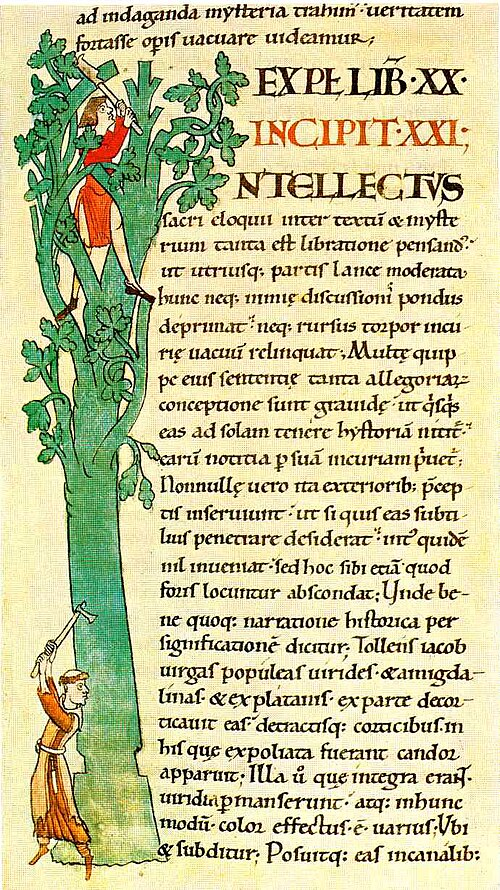
Reading for pleasure and as an experiential activity? How could this look like? I leave you with a quote from Illich on how people enjoyed their reading in the 12th century before they all became more efficient, i.e. bookish. I’ve never read a description of an intellectual practice that is so akin to wine tasting.
“The reader’s ears pay attention, and strain to catch what the reader’s mouth gives forth. In this manner the sequence of letters translates directly into body movements and patterns nerve impulses. The lines are a sound track picked up by the mouth and voiced by the reader for his own ear. By reading, the page is literally embodied, incorporated.”
(Illich, 1993, In the vineyard of the text: A commentary to Hugh’s Didascalicon, p. 54)

Leave a Reply